In the early 1920’s, life was not easy in South Louisiana. Nor was it much better in Sicily where an orphaned young man hungered to start a new life in America. With limited opportunities in his native country, Joseph Rizzo, a boy of eleven, needed help to cross the Atlantic.
Joseph Rizzo’s journey from Palermo, Sicily to the United States began in 1905 as he walked along the cobblestone streets of the historic Italian city. All around him, the sights and sounds of a bustling seaport enveloped him, surprising him, even frightening him. The port was a hub for commercial shipping to global trade routes and in the early part of the 20th Century, it played a significant role for Italians emigrating to the United States. The young Rizzo could have passed historical churches and palaces dating back to the 9th Century, taking in the architecture and influences of Greek, Roman and Byzantine rule. But with a few personal possessions and the clothes on his back, the boy was mainly focused on boarding a ship that would lead him to his new home and to a life away from the challenges of poverty, the Mafia, natural disasters like earthquakes, high taxes and agricultural crises that so many Southern Italians faced. All were important reasons to leave Sicily, but for Rizzo, it was the lure of a better life, opportunity, new beginnings and one day, a family of his own.
He could have been the son of an Italian fruit farmer, or the younger brother to a sister who told him to find adventure in another place. No one really knows what family if any were left behind*. We know Rizzo made the voyage without family, but he was not alone as he boarded a western bound ship to cross the Atlantic Ocean. In steerage, Joseph Rizzo was surrounded by hundreds of Italian men and women, boys and girls who also hoped to find prosperity in a new country. In fact, between around 1880 and 1924, more than four million Italians immigrated to the United States, half of them between 1900 and 1910 alone, and like Rizzo, the majority left to escape the relentless rural poverty of Southern Italy and Sicily.
After embarking at Ellis Island, Rizzo made his way to Patterson, La., under the sponsorship of Ciro Lampo, a Patterson native and Italian Consulate representative from New Orleans. Immigrating alone, the US government classified Rizzo as an orphan, consequently he needed a sponsor to enter the country. Lampo initially brought Rizzo to South Louisiana to work in the sugar cane fields. He worked for a month on a Patterson plantation but then began working for a Morgan City truck farmer, getting paid $4 a month that included room and board.
In a June 23rd, 1969, article written by Marilyn Hudson and published in The Daily Review, Rizzo said, “Our employers were Italians, and I wasn’t learning the English language so after two years, I went to work at the, now defunct, Cotton Bros. Sawmill, also in Morgan City, for $1 a day.” His sawmill career ended after narrowly escaping death when his clothes caught in the main shaft, but thankfully loose and ill-fitting clothing he was wearing, saved him.
The path Joseph Rizzo found himself on; leaving his home in Sicily, a long voyage across the Atlantic Ocean, working in the sugar cane fields, a sawmill, as a daily laborer for a truck farmer, all occurred between the ages of 11-16. The journey from child to adult happened quickly for the young immigrant, but despite the difficulties, he worked hard and never gave up his dream of owning a business and being successful. For a brief time, as Rizzo was getting his entrepreneur legs under him, he opened a grocery delivery business. He would buy meat and other supplies from the outdoor Morgan City market that lined Front Street, then deliver these items by horse and buggy to rural areas in St. Mary Parish making a small profit from the items he resold.
At the age of sixteen, he entered the clothing world when he became an unpaid apprentice for Sam Caro, a Morgan City tailor. Needles and thread, fabric and sewing machines suited him and by 1912, Sam asked Joseph to partner with him and open a Patterson branch. For the self-taught young entrepreneur, this would be a turning point for Joseph and his dream of owning his own business was becoming a reality. It was a modest beginning. During that first year of the Caro-Rizzo partnership, as their total inventory, including supplies, a 20 lb. charcoal iron and a sewing machine totaled $176.
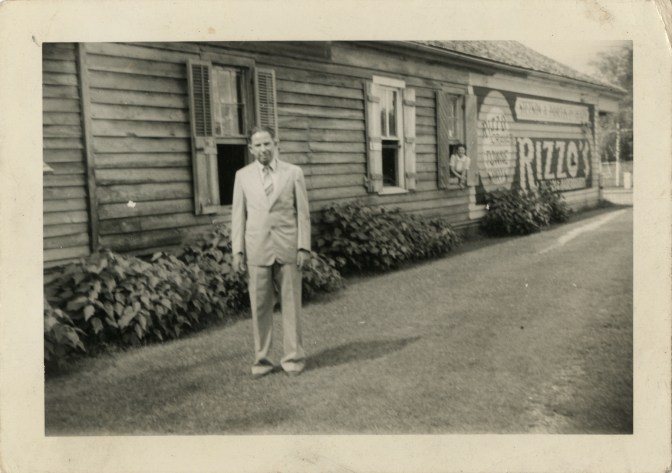
After the death of his partner, Rizzo took over the entire company and the Rizzo Tailor Company continued to prosper. As a tailor, Rizzo’s skills at making suits, sportscoats, and pants garnered attention from many well-known and important individuals who lived in the area. Politicians serving in the Louisiana House of Representatives, the mayor of Baton Rouge, doctors and other professionals were his customers. Another well-known Patterson resident, Harry P. Williams, the owner of the Patterson Airport and the Harry P. Williams Cypress Sawmill, was a top customer, as was world famous Air Racing Pilot, Jimmy Wedell, Harry’s partner in the Wedell-Williams Air Service. Rizzo made a new tailored suit for Wedell for every major air race or world speed record attempt he participated in.
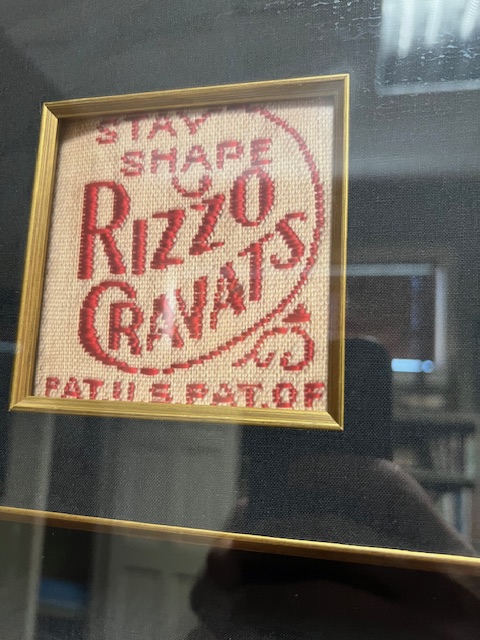
During the Great Depression, Rizzo tinkered around and invented an unusual necktie that retained its shape even after being cleaned and pressed, something unheard of in those days. On March 6, 1934, Joseph Rizzo obtained a patent in the US and Canada for his Sta-Shape “Rizzo” Cravat”. The tie was unique in that it was constructed with a lining made from the fine long hair of the alpaca, a domesticated animal of Peru, and special stitching that would prevent it from twisting out of shape.
In the same 1969 Daily Review article, Rizzo told the writer, “I wanted to invent something that no one else had and decided to develop a necktie which could be cleaned and pressed and would still retain its shape.”
After receiving his patent and six months of determined labor perfecting and developing, Rizzo began selling the Sta-Shape “Rizzo Cravats” three for $1 in the latter part of 1934. “That was expensive in those days when ties sold for 10 cents apiece,” he recalled.
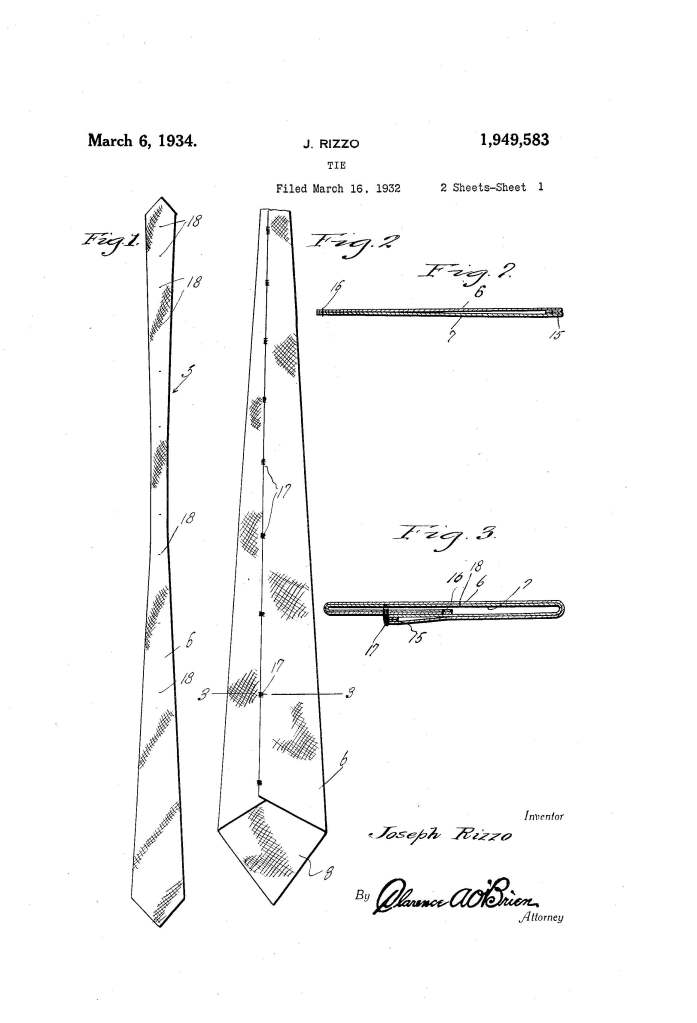
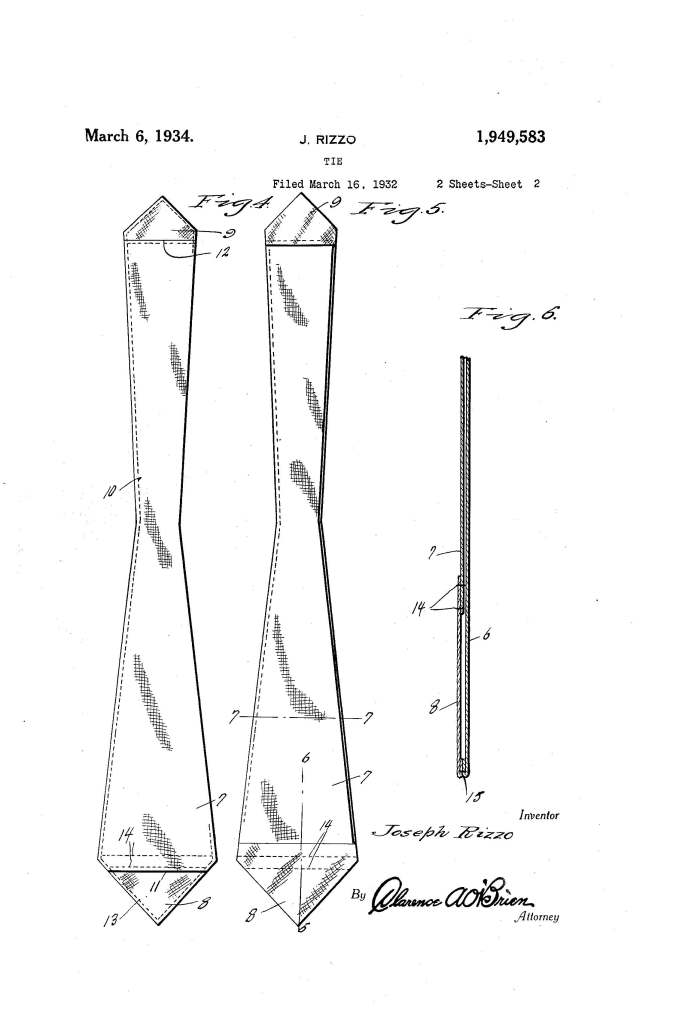
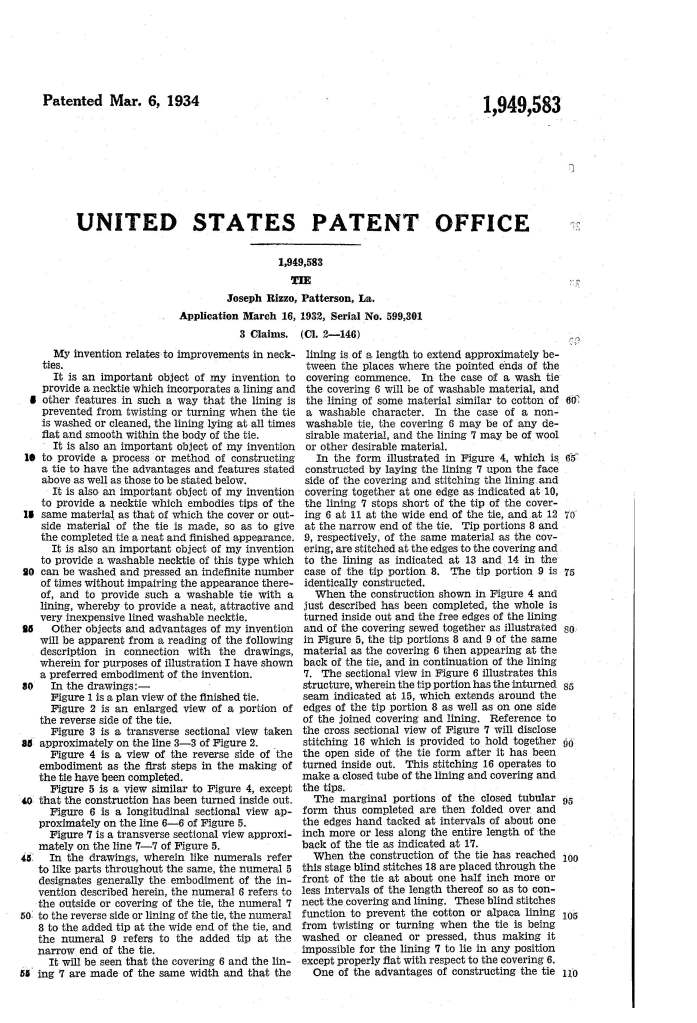
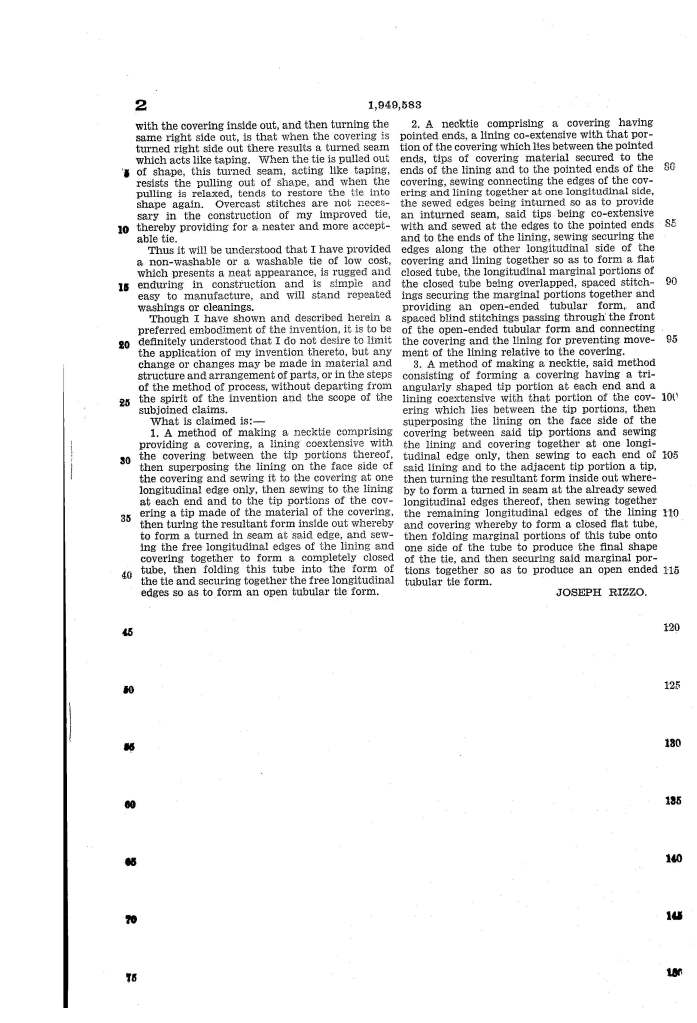
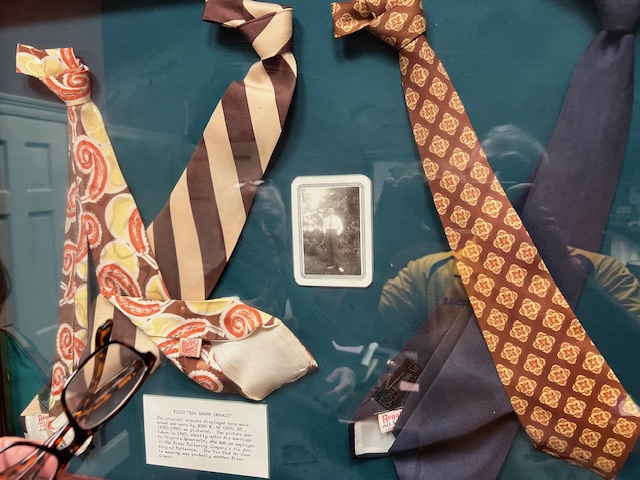
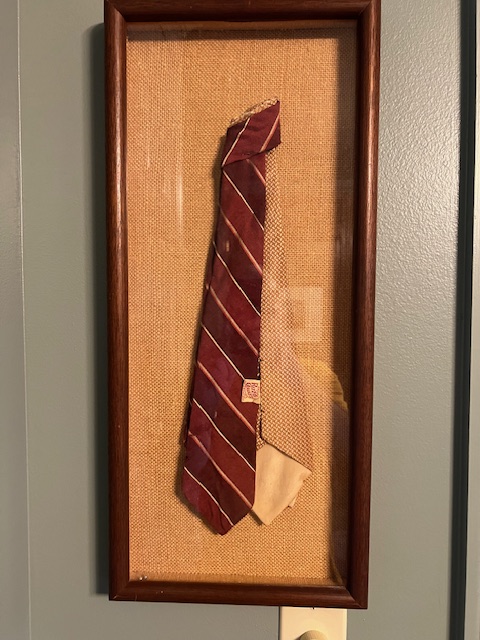
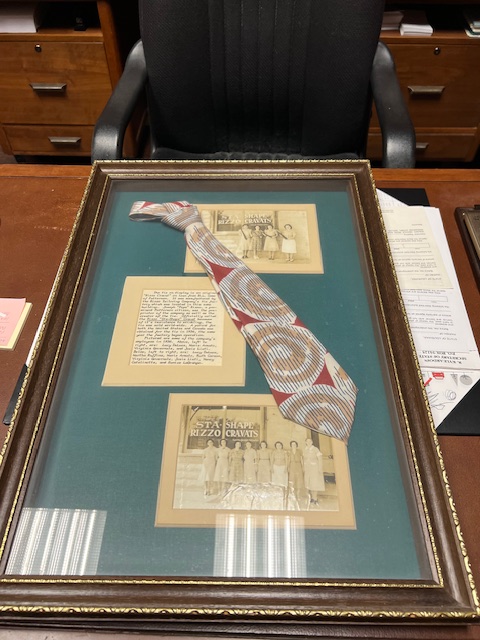
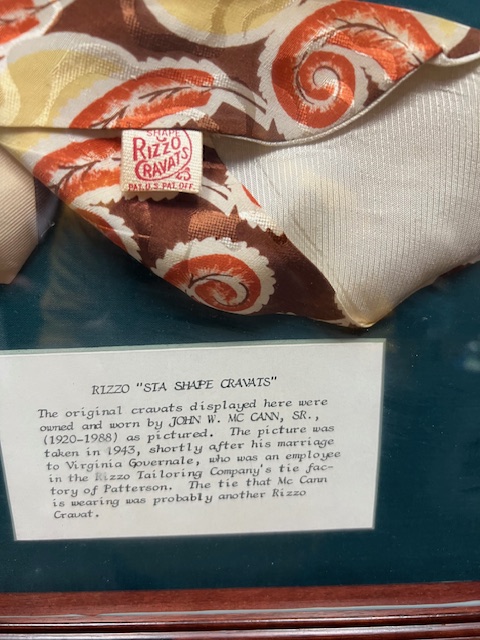
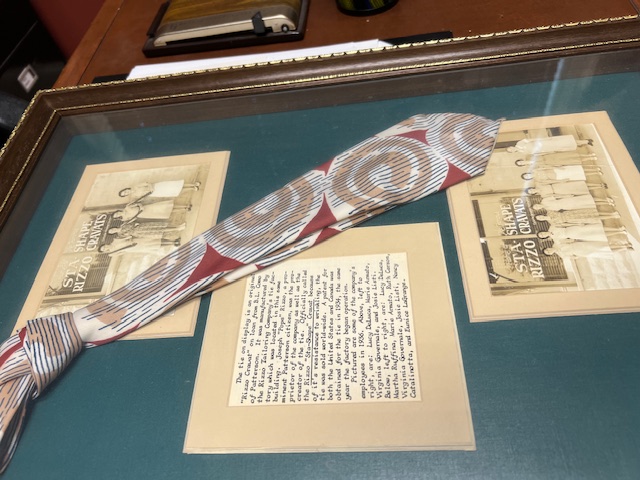
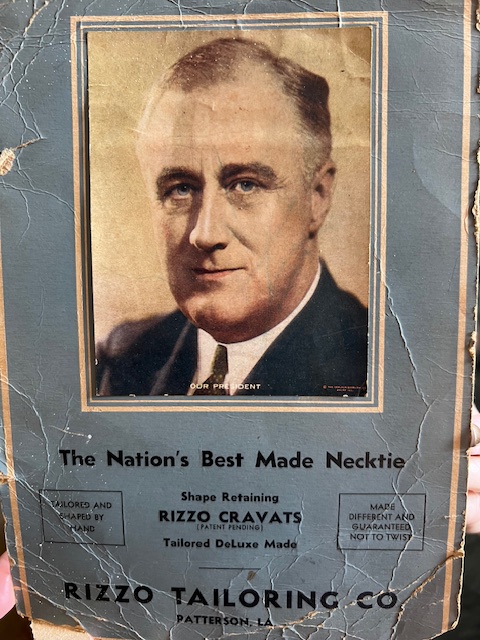
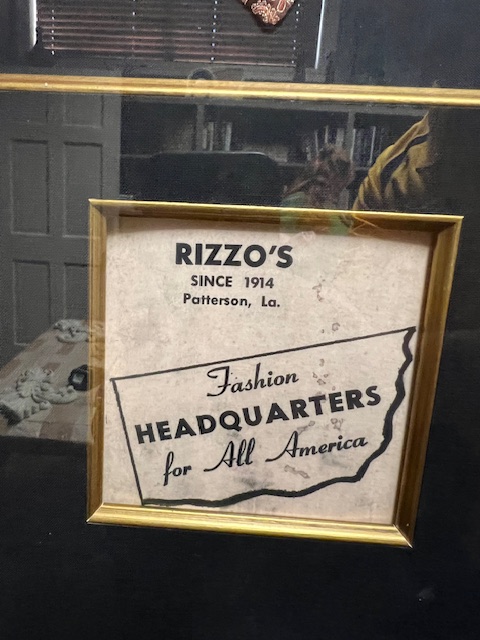
The “Rizzo Cravat” became so popular that by 1941, the company’s staff had increased from two employees to fifteen and production averaged 16 dozen ties per day. Sta-Shape “Rizzo Cravats” were not only sold throughout Louisiana but in major cities in Texas, and Mississippi.
When materials he required for his ties became scarce during World War II, Rizzo sold his business on a royalty basis, receiving fifteen cents per dozen ties sold. The new owner operated it two years and was forced to close. Shortly after, he sold the patent to the Wembley Tie Company in New Orleans.
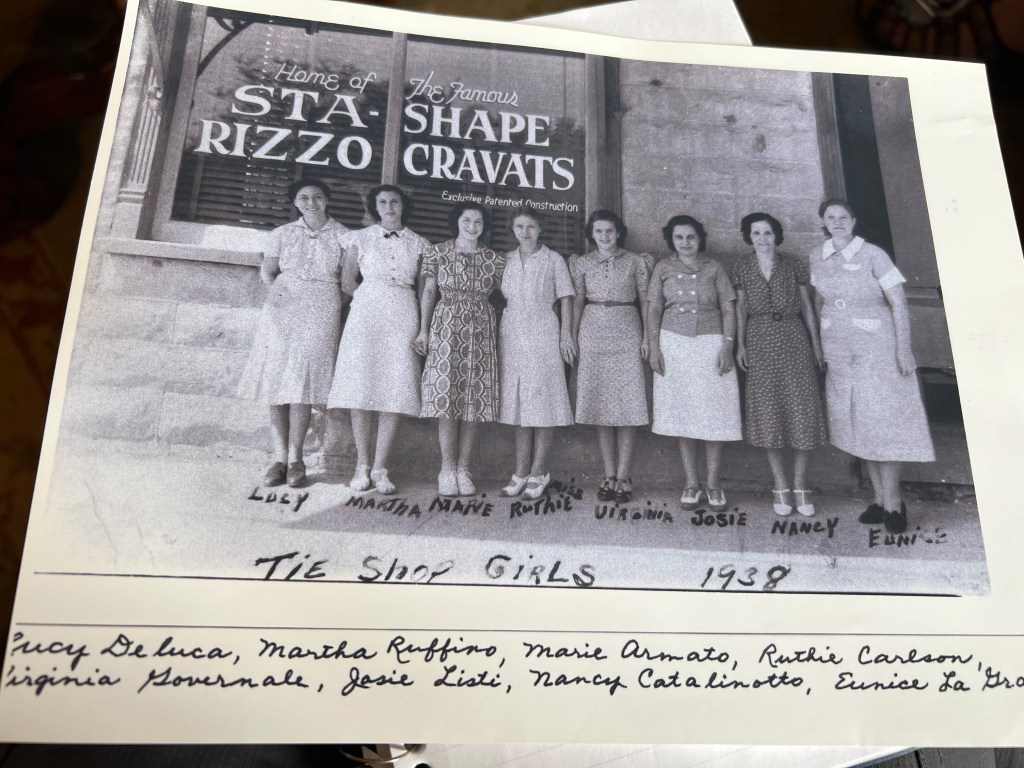
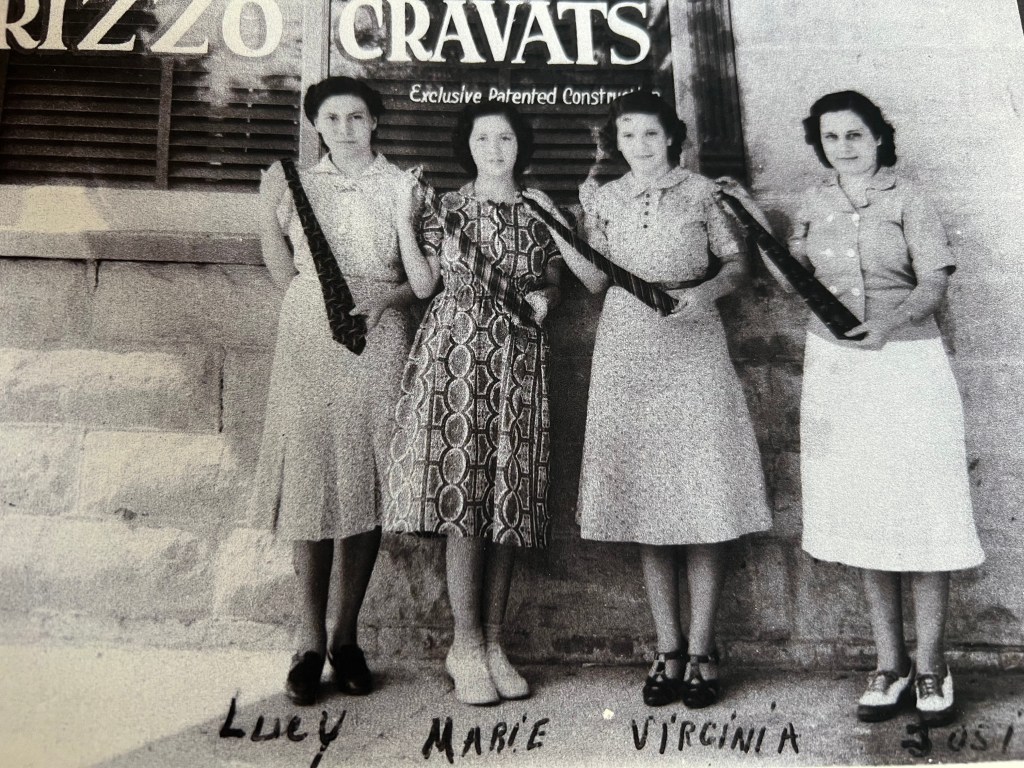
In 1938 a picture was taken in front of the Rizzo tie factory listing Lucy Deluca, Martha Ruffino, Marie Armata, Ruthie Carlson, Virginia Governale, Josie Listi, Nancy Catalinotto and Eunice LaGrange with the caption “Tie Shop Girls.” The building where the picture was taken and used to manufacture the ties is still standing in downtown Patterson and is currently used as a retail business.
In 1942, Rizzo and his daughters, Agatha, “Aggie” and Clara Marie, “Ree”, opened “Rizzo’s”, a men’s and women’s clothing and apparel shop in downtown Patterson. This successful business operated in the same location until it closed in 1984.
Designing neckties and operating successful retail businesses were not the only successes in Joseph Rizzo’s life. When he came to the United States, he only had 5 years of formal education, all of which took place in Italy. Once Rizzo learned to speak and read English, he became a prolific reader and when he wanted to know how to do something, he would buy a book on the subject.
Jocklynn Keville’s article written for The Daily Review and published on April 30, 1981, “Rizzo Finds ‘Land of Opportunity’ in Patterson,” she quoted Rizzo saying, “I used all the money I could come up with then to buy books. I first bought a book to learn English. Then I bought books to learn the operations of government.”
The article goes on to say: “Rizzo learned enough about government from books to enable him to land a seat on the St. Mary Parish Police Jury in 1951. After that, he got on-the-job training for anything else he needed to learn, which judging from his record, was not a whole lot.”
During his 21 years serving on the police jury, Rizzo fought long and hard to make Patterson a better place. He was the first man to use the jury’s road money for projects inside corporate limits, and he did this because he wanted to blacktop all streets leading to schools and churches in Patterson.
“The district attorney said it couldn’t be done,” said Rizzo referring to the road money, “but there’s more than one way to kill a cat.”
So, Rizzo went to the attorney general to gather information. From there, he formulated his plan. “While we were working on the streets,” Rizzo recalls, “we would give them to the police jury. After the construction was completed, the police jury would give them back to the city.”
Rizzo did a lot for Patterson using such political finesse. In a column that appeared in The St. Mary Banner and Franklin Tribune, Rob Angers Jr., writing about Rizzo said, “St. Mary is his parish, and Louisiana is his state, and the USA is his country, but Patterson is nearest and dearest to Joe Rizzo’s heart. It’s his home and his place of business and his source of pride and if you want to have a battle on your hands, just run down his community.”
Angers continued, “And more powers to fellows like him who are constantly looking for ways and means to build up their communities. Perhaps most of us should borrow a page from Juror Joe Rizzo’s textbook of community building. He never stops fighting for what he thinks will benefit Patterson.”
In many ways, the small town of Patterson has changed in the decades since I was a boy and lived there. Earlier this year, Brightman Kornegay, a grandson of Rizzo, took me inside the ruins of the former “Rizzo’s” clothing store. All that remains are the outer brick walls as the insides have long been gutted and the roof is gone. The old floor tiles remain, scattered in places and although the building is a shell of its former grandeur and functionality, in my mind’s eye, I could see what it was, so long ago.
The remnants of a faded “Rizzo’s” clothing store advertisement can still be faintly seen on the outer bricks of the old building. Sammy Dangerfield, Sr., and Sammy Dangerfield, Jr., both of Patterson, painted the advertisement in the mid-1900’s.
Standing there in the guts of the former business, I could remember walking into the store with my mother, a child of 7 or 8, in the early 1970’s. So many fancy and beautiful dresses hung from racks and wall displays, mannequins adorned with the latest fashion trends. There was a raised section within the building, about halfway back from the front door that housed the men and boy’s department. I can still picture Mr. Rizzo sitting by his sewing machine that was sitting on a table in front of a window. Mom shopped and I wondered around hoping she would find a new dress sooner rather than later because I knew as soon as we left Rizzo’s, we could go next door to buy a snowball from Adams Snowball Stand, that stood in a small alcove between Rizzo’s and Ramos’ Bar, and which was owned and operated by Rizzo’s grandchildren, Jerry, Robert, and Joey Adams.
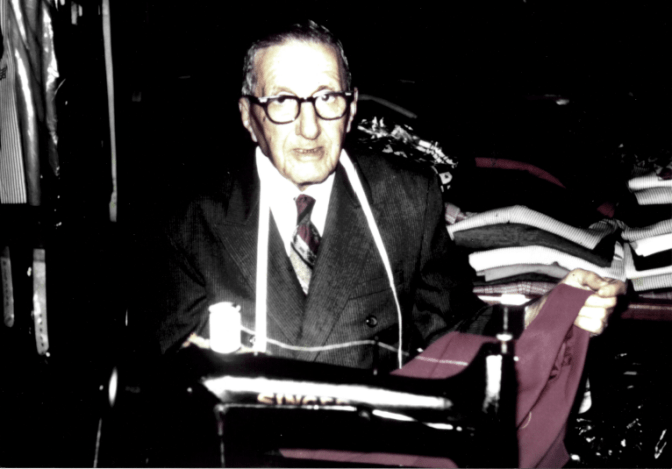
While visiting Brightman, I learned a great deal about his grandfather and the work he did in and for the town of Patterson. Through his words and stories, I could feel the pride that Brightman felt for his grandfather. The same could be said when grandchildren Jerry Adams, Wendy Kornegay Rowley and Cathy Kornegay Walter also shared their memories about Pops Rizzo.
Overwhelmingly, it was not difficult to see that Joseph ‘Pops’ Rizzo didn’t just instill a strong work ethic and a quest to learn and receive an education, but he would leave a legacy that went beyond family, but also to the town he embraced and loved from the moment he first walked its dirt and gravel streets: the town of Patterson, Louisiana.
The life of Joseph Rizzo is filled with accomplishments and successes that also reflect a boy who had to grow up quickly to overcome adversity and poverty. Determination and a strong will to survive and beat the odds that any betting man would have said, were too high to make a mark in this world. But men like Joseph Rizzo were pioneers, innovators, and men who embraced the American spirit needed to conquer the obstacles in their way at the turn of the 20th Century.
The structures and man-made entities where men like Rizzo may have lived and worked, raised families, shared coffee, or played a game of pool, might be long gone, but what remains and carries on are the legacies they created, molded, galvanized for future generations.
After settling in Patterson, establishing, and growing his tailoring business, Joseph Rizzo married Genina Lampo in 1917. Genina was the daughter of Ciro Lampo, the man who sponsored Rizzo when he immigrated to the United States. Over the next seven years, Joseph and Genina had three children, two daughters, Agatha (Aggie) and Clara Marie (Ree), and one son, Francis.
Aggie married Thomas Wilson Brightman Kornegay, Sr. and they had four children, Cathy, Jo Jean (Jeanie), Wendy, and Brightman.
Ree married Robert A Adams, Jr., and they had three children, Jerry, Robert III, and Joseph (Joey).
Francis, who died at age 18, never married and had no children.
With the arrival of kids, so came the name that Joseph Rizzo would forever be known by, Pops. The moniker came from daughter Aggie. Cathy, the first grandchild would cement Pops as the name friends and family moving forward would call the senior Rizzo.
“Pops was self-taught. He educated himself by constantly reading,” Wendy Kornegay Rowley says as she reflected on her grandfather and his forever quest for learning and knowledge. “As a child, I remember the tradition of sharing every report card with Pops. He rewarded “A’s” with money. As part of the ritual, Pops would offer encouragement about working harder to achieve success. He valued education and hard work.”
He would lead by example, Jerry Adams, said about his grandfather.
“He was always at the store early (30-45 minutes) before opening time, and if he saw anyone standing outside, he would open early and welcome them in. At closing time, he would only close after the last customer left, even if it were well after closing time. He never ran a customer off.”
Whether at work or shooting pool at the local pool hall with men in the community or relaxing at home, Pops Rizzo took his appearance, seriously. “I do not ever recall not seeing him dressed in a suit, or sport coat, and tie, and his tie was always tied tight in a Windsor knot. He never loosened it and unbuttoned his shirt. He only took his coat off to play pool or cards, or while working in the store,” Adams continued as he reflected on his grandfather.
The lessons and habits the children and grandchildren of Pops learned at an early age still resonate decades later.
“To this day, I think about him fondly every time I wear a suit and tie, and I still dress according to what he taught me regarding colors, stripes and patterns. Also, when I am standing outside of a business/store/restaurant, etc., waiting for them to open while the employees inside are checking the time to make sure that they don’t open one minute before the scheduled opening time, I can’t help but think that’s not how Pops ran a business,” Adams says.
Brightman Kornegay remembers how detailed-oriented his grandfather was, teaching his grandson to account for every penny that came in and out of the business. Kornegay would pour over the dress shop’s books, his grandfather’s investments, each Certificate of Deposit (CD), and if rounding up even a fraction of a decimal point saved a nickel, Pops would do it.
Several days after walking through the old store with Brightman, I met him, Jerry, and Cathy at Cathy’s home in Uptown New Orleans. I settled into Cathy’s living room, with a cup of coffee in my hand and watched as the three grandchildren pulled out old photos, yellowed newspaper clippings, antique memorabilia, and other items that reflected the life of Pops Rizzo and his family. I tried to keep up with the tidbits and anecdotes each were throwing out as they remembered things from their time with Pops.
A photograph or a Daily Review newspaper article would jolt a memory leading to another fact being shared. I could not keep up with who said what, but the information told brought more to light about a poor immigrant from Sicily who came to the United States to create a life that otherwise, he would never have known.
Jerry brings up the Thursday night spaghetti dinners where Pops’ house was a gathering place for the entire family. Brightman talks about Pops desire to see the streets of Patterson paved or blacktopped. Cathy shares details of when her mother, Aggie, and Jerry’s mother, Nannie Ree, ran the dress shop and even as young as ten, Cathy would work alongside her mom and aunt helping customers who came into the store. Jerry recalls Pops saying no politician should be paid, they should do the work as a public service. Someone else mentions that once Pops left Italy, he never looked back, saying he “appreciated what was given to him and he planned to put down roots and stay in Patterson.”
Someone asks, did you know that Pops was instrumental in getting Trans Texas Airlines (TTA) to serve Patterson, making our airport one of its stops?
(The airline started in 1944 and headquartered near William P. Hobby Airport in Houston, Tx., was a regional carrier that later became Texas International Airlines in 1969 and then eventually merged with Continental Airlines in 1982.)
As much as Pops Rizzo loved his adopted residence of Patterson, always wanting to see it thrive and grow, he cared about the people who lived there, even more. I heard numerous examples of Pops generosity where he gave money, clothing, and assistance to so many.
Martha Murphy Chauvin shared, “When my mother and daddy divorced, Pops decided daddy had to look different to get better. He picked out clothes for daddy, altered them, and made sure he wore them on weekends. He did not charge daddy a thing. But at a difficult time for daddy, his (Pops) unique friendship was appreciated. Pops was a truly good man in our community.”
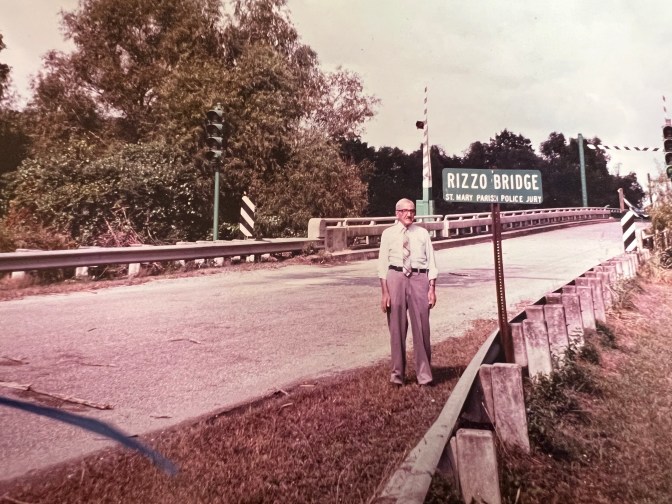
Pops also understood that not everyone had the available funds year-round to pay for items in his store. This was uniquely the case for the sugar cane farmers and their families, who at one time were only paid once a year, and only when the sugar cane crop had been harvested and sent to the mill. To these and others needing assistance, Pops provided credit to anyone in town.
Before leaving Patterson, I found Pops’ tombstone that is in the St. Joseph Catholic Church’s cemetery. It has been over 40 years since he died but after spending time with family and friends who knew Pops so well, I am once again reminded that his legacy lives on. Before she was tragically killed in an automobile accident, Pops’ granddaughter, Jo, wrote a tribute to him. Jo’s words are a fitting compliment to a man who loved his friends, family, and his adopted hometown of Patterson. The epitaph on his tombstone reads:
Joseph ‘Pops’ Rizzo died March 6, 1983
A Tribute to Pops
From Sunny Italy hailed Pops, who all of us think is tops.
Jo Kornegay Thomas
A boy of eleven from across the sea, chose Patterson as his home to be.
This boy from afar, made Patterson his shining star.
With his townspeople foremost in his mind, his contributions were one of a kind.
Serving as councilman for 12 years, with deep civic pride, blood, sweat and tears.
In his 21 years Police Juror role, he reached his highest goal.
This is the way his life went, being an extremely good public servant.
* No one really knows what family if any were left behind. Although previous articles mention family members that Pops may have left behind in Sicily or traveled with him to the United States, family members interviewed said to their knowledge, Pops did not have any family and came alone.


