It was early May in South Louisiana; the oppressive heat and humidity of summer was still a few weeks away and I needed to get on my way to baseball practice.
I pulled on the garage door until the weight of the door shifted onto heavy tension springs allowing the door to glide open to my touch. Inside the garage I moved my dad’s lawnmower to the side giving me room to free my black and gold Western Auto bicycle away from a knot of shovels, rakes, and a garden hose. The curled handlebars—shaped like the horns of a ram—were perfect for securing my baseball glove after sliding the mitt over the plastic-fitted handle grips.
My elderly grandmother, Grandma Sallie, came around the corner of our home at 506 Rosemary Street, warily looking at me. She walked over as I mounted my bike to start pedaling away toward practice but she held me back and asked,
“Did you finish your homework?”
“Yes grandma, all done,” I replied.
She smiled and patted me on the head, pushing the brim of my Knights of Columbus baseball cap down over my eyes. “Grandma, stop it,” I playfully squealed, always cherishing these moments with my grandmother. With both parents working most of the time and having lived with us since I was 6 months old, Grandma Sallie practically raised me.
She taught me to appreciate the Heaven and Earth that God created. She taught me to see the beauty in flowers and trees and to appreciate the cool, gritty feel of soil that had been recently tilled and spread. She urged me to breathe in the fragrance of a magnolia bloom, honeysuckles, freshly cut grass, the pine needles that danced on the limbs of the four Slash Pine trees I helped my dad plant in the front yard.
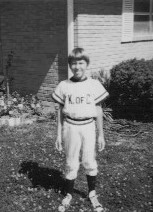 My grandma loved flowers. She created beauty by planting flowers, shrubs, bushes, trees. She loved the work involved in planting, watering, nurturing and even weeding around the many varieties of blooms and blossoms her green thumb could coax out of the earth. Grandma Sallie was happiest when the sunshine was on her skin, beads of sweat slipping down her brow, a shovel in her hands and a chance to be alone with the Creator of everything beautiful, her Father in heaven.
I waved goodbye to my Grandma and before she could ask any more questions, I was turning off Rosemary Street, heading up Church Street to connect with Main Street. I rode on Main Street’s sidewalk, navigating crumbling patches of cement and pedestrians until I turned into the Protestant Cemetery, so I could follow a trail through a narrow patch of woods that backed up to the baseball diamond.
After I pulled into the cemetery, my pace slowed, my eyes scanning every grave I could see and epitaph I could read. Before me were the graves of early residents of Patterson, people who shaped the small logging, fishing and agricultural community on the Lower Atchafalaya River.
Despite its name, the cemetery is the final resting place for Catholics, Methodists, Jews, Baptists, Presbyterians and many who never called any church their home. Side by side, the dark soil knows no religion, just names, dates, expressions of love written by loved ones left behind. For most, the cemetery was the benediction of a physical life that had parted the earthly realm allowing its soul to cross to the other side.
Even as a young boy, I looked at cemeteries not just as a place to bury the dead, but a place where people with unique stories could be found. I saw memories. I saw laughter and tears, sweat and blood. Graves lined up side by side with the same last name reflected families; moms and dads, grandparents, children.
Who were these people? In life were they happy, sad, rich, poor, ambitious, greedy, humble, prone to doing good or apt to fall into a life of disrepair? Were they farmers or shrimpers? Perhaps they raised sugar cane? Were some preachers, just like my dad, sharing the story of God’s love or were some prostitutes who never felt like anyone, including God, could ever love them? There were graves of wealthy men who owned acres and acres of land, as well as the rugged lumberjacks hired to clear the land. The doctors who cared for people could be found next to a young boy or girl who may have died during a yellow fever epidemic.
I was always drawn to the gravesides of those who died serving their country. Some made the ultimate sacrifice after voluntarily joining the military, while others became Marines, Army soldiers, or Navy sailors, not by choice but at the hands of the draft. A vibrant soul that left the Earth in a rice patty in Southeast Asia or on a rocky beach in France or on the deck of an aircraft carrier all now side by side despite the time and space between each story.
On every bike ride through the cemetery I purposely slowed or stopped at one grave. It was the burial place of someone I knew. It was someone who died too young in a faraway place, leaving behind grieving parents and lives forever scarred. The Vietnam Conflict claimed the lives of many men and women, including the life of Raymond Page Johnson (read more).
Pausing at Page’s resting place, hazy images clouded my mind. Stories about a soldier jumping from a helicopter, a tiger waiting in tall grass, enemy gunfire, crying, heartache, the sound of rifle fire echoing off nearby houses, an American flag folded neatly and handed to a heartbroken mother. Had I actually heard the sharp crack of rifle fire from a line of soldiers saluting a fallen comrade? Had I seen Page’s mom and dad weeping and sitting before a flag-draped coffin or had the stories and images in my head been told to me? I didn’t know. Memories so real yet fleeting.
The rattle of a rusty bicycle chain pulled me from my emotions. A teammate zoomed by, yelling something at me that I didn’t catch. I got back on my bike and followed my friend who headed toward a wooded area at the back of the cemetery. This patch of trees, palmettos, bushes and weeds was really just an overgrown part of Cypress Road that had never been cleared for development. More than anything, it was a place that was perfect for my favorite fruit to grow in abundance.
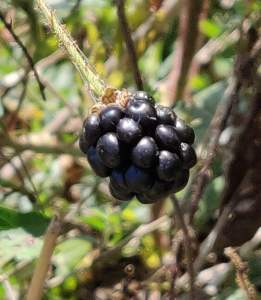
I was about halfway through the woods when I spotted a thicket of the sublime Rubus Fruticosus. My mouth watered, my hands tingled, my eyes gleamed peering at the hundreds of juicy, dark purple blackberries woven into the bush in front of me. In the distance I heard the coaches telling players to start warming up but the idea of devouring fresh blackberries straight from their thorny perches overpowered me.
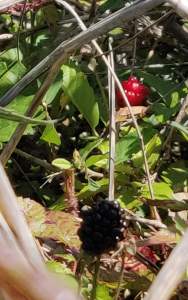
Blackberries here, blackberries there, blackberries everywhere. Two at a time, three at a time, all shoved in my mouth. Before long, my mouth and hands were dripping with the juices and scraps from my feast. My t-shirt and cut-off jean shorts were permanently stained and my fingers stung from cuts complimentary of the thickets, but this paled to the smile on my face and the rhapsody of fruity delight churning in my full belly. I knew that I was supposed to be at baseball practice and my coaches were expecting me. Out of everyone on the team, I was the one who needed to practice the most. I was a late baseball bloomer, my prime still years in the future. Dixie Youth baseball or blackberries? Well, on this day, I chose blackberries.
Sticky and stained, I picked up my bike and headed back home. Missing that day’s practice wasn’t going to help or hurt me. My ride home was slower but my smile was wider.
Grandma Sallie was still in the front yard tending to her flowers when I pulled into our driveway on my bike.
“It looks like blackberries were more important than baseball,” she said.
“Yes, ma’am,” I said meekly, not sure if she was upset with me or not.
I tried to get off by blaming my berry bloodied face and hands on my friend Rubus Fruticosus, someone that I had only recently met.
“Butt-us Belt-icus…if you are not cleaned up before your Daddy gets home,” Grandma calmly yet sternly asserted as she turned back to her flowers.
It didn’t take long for me to get cleaned up.

 Pinball & Preachers
Just Great and as accurate as i can remenber Take Care Son Frank
LikeLike
Thank you Mr. Frank. I’m always so happy to hear from you. I have another chapter of Carpooling with Carlos coming out soon.
LikeLike
Great read Steve, like in all your stories it feels as though I am there. Even though I was not. Keep up the great work.
LikeLiked by 1 person
This brings me home. The streets and cemetery were where I spent many a day growing up on the corner of Wise and Leonard Street. When headed to the library on my bike, I couldn’t wait to get my newly checked out books and go sit in the cemetery and read. You have a gift for capturing your readers attention and lift their day. I wish you an abundance of prosperity in your writing.
LikeLiked by 1 person
Torri, you and I have similar memories and experiences growing up in our little town. Thank you for reading. You reminded me of another story I need to write and for that I say thank you again. I’ll start working on my Patterson Public Library and my love for reading story soon.
LikeLike
Shirley, thank you for reading and for the encouragement. I love that you feel like I took you there in my stories. More to come.
LikeLike
Very well written Steve. A great memory. I too find great benefit by taking time to reflect in a cemetery. Everything becomes very clear when reading tombstones.
LikeLike
Awesome read Steve. Thanks for sharing.
LikeLiked by 1 person
Joe, thank you for reading and enjoying my story.
LikeLike